Key Takeaways
- Plywood outperforms particleboard on screw-holding strength, moisture resistance, and long-term rigidity, but particleboard costs less and works fine for low-moisture, low-load cabinet parts.
- A 3/4 inch plywood shelf spans roughly twice the distance particleboard can before sagging under the same load, because plywood's cross-laminated grain resists deflection along both axes.
- Particleboard swells fastest at the toe kick and under the sink, the two spots most exposed to standing water and dishwasher leaks.
- The price gap between a particleboard box and a plywood box typically runs $10 to $50 per linear foot for a standard base cabinet run, a small fraction of a full kitchen remodel budget.
- California's CARB Phase 2 rules cap formaldehyde emissions at 0.09 ppm for particleboard, 0.11 ppm for MDF, and 0.05 ppm for hardwood plywood, so composite cabinet boxes sold here must meet those limits.
- In the Sacramento Valley's triple-digit summers and dishwasher-adjacent humidity, plywood's dimensional stability matters more than in milder climates.
Plywood vs particleboard cabinet boxes: the short answer
Plywood is the better material for cabinet boxes in almost every case where the box will bear weight or sit near water, because its cross-laminated veneers resist swelling and hold screws far longer than compressed wood chips. Particleboard is the honest choice only where cost matters more than lifespan, such as a rental flip, a garage cabinet, or a box that will be replaced before it ages out.
Cost is the reason particleboard exists at all. A particleboard box typically runs $10 to $50 per linear foot less than an equivalent plywood box, and that gap adds up fast across a full kitchen run. On a project where the cabinets themselves are getting replaced in five years anyway, or where the box sits in a dry, low-traffic space, spending the extra money on plywood does not pay back.
Particleboard becomes the wrong call the moment a box sits under a sink, holds a heavy stand mixer on a pull-out shelf, or needs to survive 15 to 20 years of daily use. That is where the material difference stops being a spec-sheet detail and starts showing up as a sagging shelf or a swollen toe kick.
Choosing the box material for your remodel
Match the material to where the cabinet sits
Specify plywood boxes for any cabinet run near a sink, dishwasher, or exterior wall exposed to Sacramento Valley heat cycling, and reserve particleboard for dry, low-load cabinetry like a pantry or a laundry room where cost matters more than a 20-year service life.
Weigh cost against how long you'll own the home
Weighing cost against service life comes down to how long you plan to own the home and how much daily load the cabinets take on: a kitchen you're renovating to sell in a year tolerates particleboard fine, while a kitchen you'll use daily for a decade or more earns back the plywood premium in fewer repairs and less sagging.
Get an honest recommendation before you sign
GVD Renovations runs a design showroom in Rocklin (6848 Five Star Blvd #6) where you can handle plywood and particleboard box samples and see core edges before choosing, backed by a 4.9/5 rating across 921+ reviews. If you're weighing this decision for an actual remodel rather than a hypothetical one, get a free in-home consultation with GVD Renovations to see the plywood cabinet options available for your kitchen and get a detailed fixed-price proposal before you commit to a box material.
What cabinet boxes are actually made of
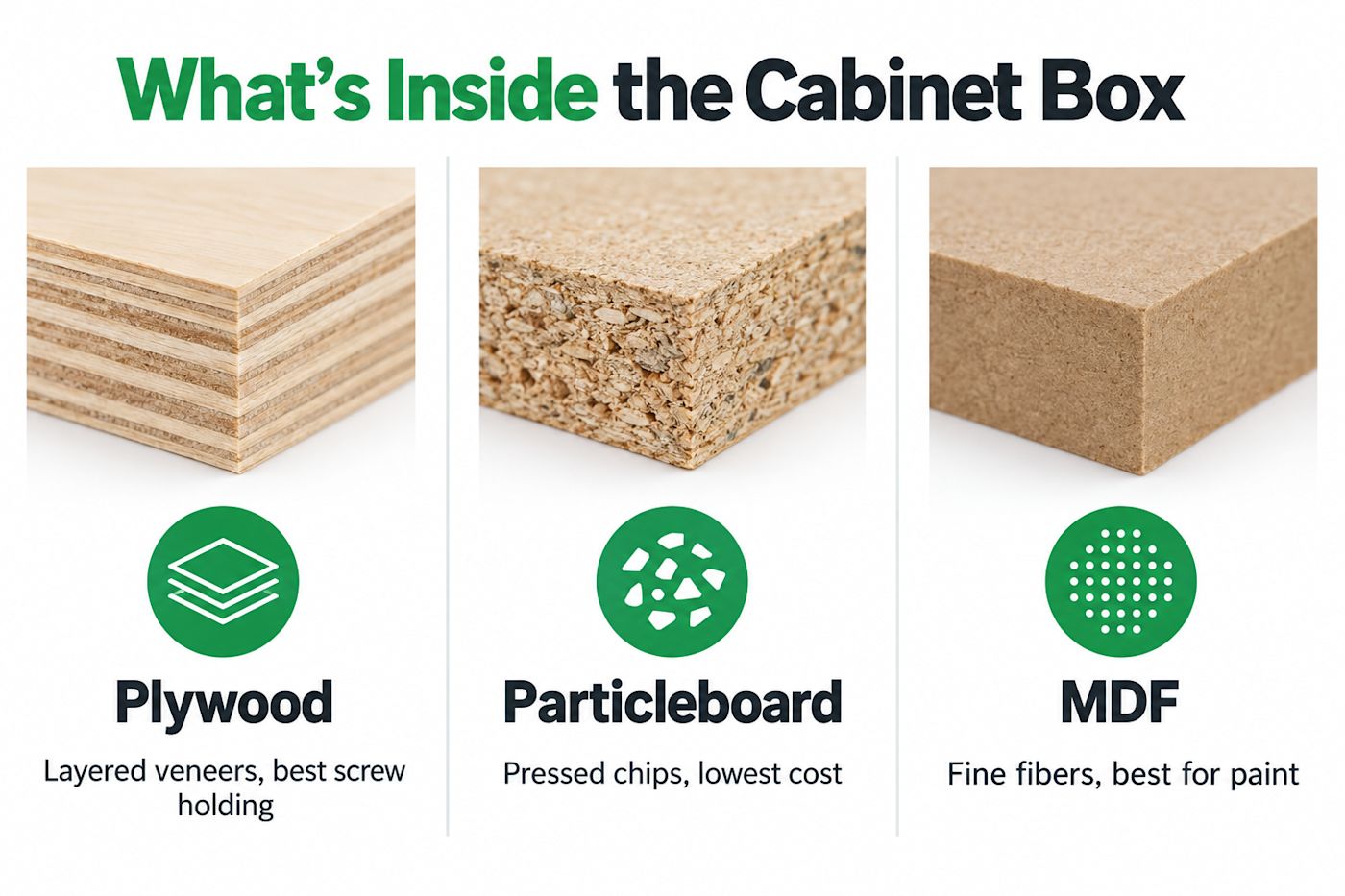
Most kitchen cabinet boxes sold in the United States today are built from one of three engineered sheet goods: plywood, particleboard, or medium-density fiberboard (MDF). Solid lumber shows up in face frames and some drawer parts, but rarely in the box itself, because solid wood moves with humidity in a way a full cabinet run cannot tolerate.
A cabinet box is assembled from flat panels, sides, a bottom, a back, and stretchers, joined with dado joints, pocket screws, cam locks, or staples depending on whether it is a site-built box or a factory RTA (ready-to-assemble) unit. The box carries the structural load; the door and drawer fronts are a separate material choice entirely, which is why a cabinet can have a solid wood door on a particleboard box.
MDF sits between plywood and particleboard on density and finish quality, but it shares particleboard's moisture weakness. Cabinet makers use it selectively (doors, panels, some face frames) rather than for full boxes, because MDF holds paint better than either alternative but sags under load almost as easily as particleboard.
Plywood: cross-laminated veneers
Cabinet-grade plywood is built from thin wood veneers glued in stacked layers, with the grain direction of each layer rotated 90 degrees from the one below it. That cross-lamination is what gives plywood strength in both directions and stops it from splitting along the grain the way a solid board would.
A veneer-core plywood uses thin wood veneers all the way through the panel, which gives the best screw holding and the lightest weight for a given thickness. A lumber-core or combination-core panel substitutes a solid wood or MDF center layer between the outer veneers, which adds weight and can reduce screw holding near the edges compared to full veneer core.
Particleboard: pressed wood chips and resin
Particleboard is made by pressing wood chips, sawmill shavings, and sawdust with resin under heat, forming a dense, uniform panel with no grain direction. That uniform structure gives it a smooth, flat surface for laminate or thermofoil, but the resin-bound chip structure has far less internal fiber length than a wood veneer, which is why it holds screws poorly and swells when it absorbs water.
The core downsides are consistent across manufacturers: screws strip out of particleboard edges more easily than out of plywood, the material swells and does not fully return to its original shape once wet, and it is 10 to 20% heavier than plywood at the same thickness, which matters for wall-mounted upper cabinets.
MDF and where it belongs
MDF is made from wood fibers rather than chips, pressed under heat into a denser, finer panel than particleboard. That finer fiber structure gives MDF a smoother edge and a better surface for paint, but MDF's density makes it heavier still than particleboard and no better at resisting water.
MDF fits best on cabinet doors, decorative panels, and face frames, where a smooth painted finish matters more than load-bearing strength or moisture exposure. It is a poor choice for a cabinet box bottom or a shelf under a heavy load, for the same screw-holding and sag reasons that rule out particleboard.
Strength and screw holding: how each material fails under load
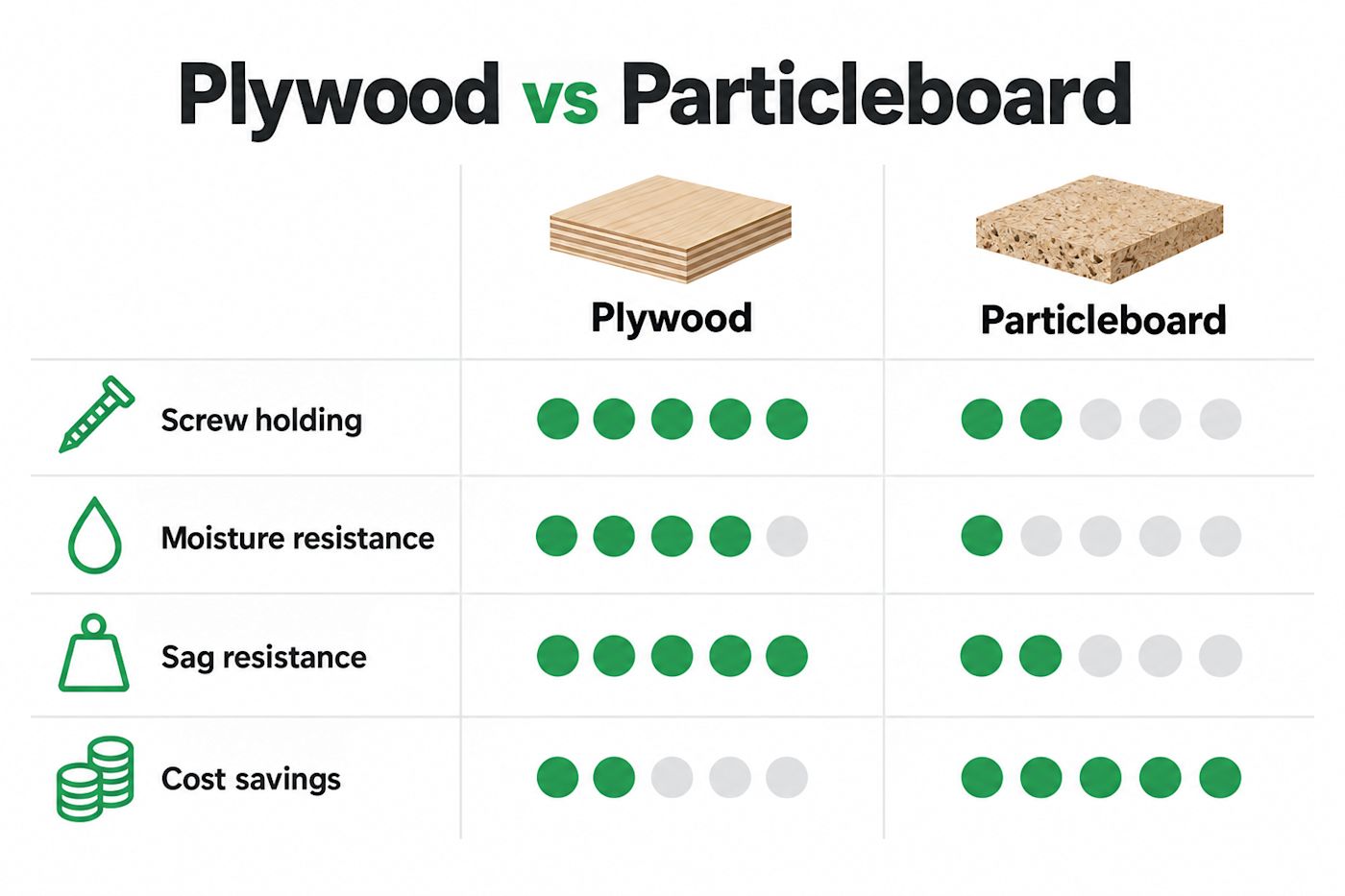
Plywood holds screws and hardware better than particleboard because its layered wood grain gives a screw thread something continuous to bite into, while particleboard's loose chip structure crumbles around the same thread under repeated stress.
| Material | Screw-holding on repeated remove/reinstall (relative) | Sag resistance on a 30-inch shelf (relative) | Response to standing water | Relative box cost per linear foot |
|---|---|---|---|---|
| Cabinet-grade plywood (3/4 in veneer core) | Highest | Highest | Resists swelling, dries without warping in most cases | Highest |
| Standard particleboard (3/4 in) | Lowest | Lowest | Swells, does not fully recover shape after drying | Lowest |
| Moisture-resistant particleboard (M2/M3) | Low to moderate | Low to moderate | Slows absorption, still not waterproof | Low to moderate |
| MDF | Moderate | Low | Swells similarly to standard particleboard | Moderate |
A 3/4 inch plywood shelf spanning 32 inches can typically support 50 to 65 pounds evenly distributed before visible deflection, while an equivalent particleboard shelf sags noticeably under half that load over the same span.
Particleboard shelves sag over time because the material has no cross-grain reinforcement, so any sustained weight, cookbooks, small appliances, canned goods, bends the panel gradually rather than resisting it. The sag is not always visible in year one; it shows up after several years of the same load sitting in the same spot, which is why particleboard shelves in older cabinets often have a visible dip in the middle.
Hinge screws and drawer slide screws see the same failure pattern. A hinge mounted into particleboard that gets opened and closed several times a day will loosen faster than the same hinge in plywood, because each cycle works the screw thread against chip material rather than layered grain. This is the most common reason cabinet doors start sagging or misaligning within a few years on a particleboard box.
Moisture behavior in a sink or dishwasher cabinet
Particleboard swells faster than plywood when exposed to standing water, because the compressed wood chips absorb moisture along every surface rather than being sealed by continuous wood layers. Once particleboard swells, it does not return to its original thickness or flatness after drying, which is why a sink cabinet floor that took on water once often stays visibly warped even after the leak is fixed.
Particleboard cabinets can handle ordinary kitchen humidity, but they do not tolerate a leaking supply line, a dishwasher gasket failure, or condensation pooling under a sink for weeks unnoticed. A dishwasher installed against an unsealed particleboard cabinet wall is a common source of slow, hidden swelling, because heat and moisture escape the appliance with every cycle and the adjacent panel absorbs it a little at a time.
Moisture-resistant particleboard, sometimes labeled MR and often tinted green, uses a wax additive and a different resin ratio to slow water absorption, but it does not make the panel waterproof. The rating means the board resists moisture longer than standard particleboard under the same exposure, not that it can sit in standing water without damage.
Plywood and particleboard cabinets in the Sacramento Valley climate
Sacramento Valley summers regularly hit triple digits, and that heat cycles a cabinet box through daily expansion and contraction that plywood tolerates better than particleboard, because plywood's layered grain resists warping across repeated heat cycles in a way loose-chip particleboard does not. Over several summers, that repeated cycling can loosen particleboard joints faster than it loosens plywood joints built with the same fasteners.
Particleboard cabinets near a kitchen sink in a Sacramento home face the same swelling risk as anywhere else, but the valley's dry summer air followed by winter humidity swings adds a second stress the material has to absorb. A sink cabinet floor that swells slightly from a small leak in July may not fully dry before winter humidity arrives, which compounds the damage instead of letting it resolve.
Thermal cycling over years affects plywood mainly at the glue line, where repeated heat exposure can eventually degrade adhesive bonds in lower-grade panels, though cabinet-grade plywood with exterior-rated glue tolerates this far longer than interior-grade stock. Particleboard is more sensitive to the combination of heat, seasonal humidity swings, and sustained load, which is why sagging shelves and loosened joints tend to show up sooner in older particleboard cabinets.
GVD Renovations offers a free in-home consultation across the Sacramento Metro area to inspect existing cabinets and recommend a box material suited to this heat-cycling and sink-moisture combination.
Cost per linear foot: what the material difference actually adds
The price difference between plywood and particleboard cabinet boxes typically runs $10 to $50 per linear foot, with plywood costing more at the material stage but less over the life of the cabinet because it needs fewer repairs and replacements. On a 20-linear-foot kitchen, that gap adds up to a few hundred to over a thousand dollars depending on plywood grade and thickness, a modest slice of a full remodel budget.
Building your own cabinets from cabinet-grade plywood can undercut factory RTA pricing on materials alone, but the labor, jigs, and finishing work involved usually erase that savings unless you already have woodworking equipment and experience. Buying factory-built boxes, whether particleboard RTA units or a plywood semi-custom line, is typically cheaper once labor time is counted, because manufacturers cut and finish panels at a scale a homeowner cannot match.
Cabinetry is often the largest single line in a kitchen remodel, and the box is only part of that cost, which means the plywood-versus-particleboard decision, while real, is a smaller lever than cabinet style, countertop material, or layout changes. Spending the extra amount on plywood boxes is usually one of the cheaper upgrades available relative to the improvement in service life it buys. GVD Renovations provides a free, detailed fixed-price proposal that states the full scope, so a plywood-versus-particleboard box upgrade is priced as a firm total before work starts rather than surfacing as a surprise charge.
Plywood thickness and grade for cabinet boxes
Cabinet boxes generally use 3/4 inch plywood for structural sides and gables, with 1/2 inch reserved for backs and some shelves. Cabinet-grade plywood differs from construction-grade plywood in veneer quality, void content, and glue rating, and that difference shows up in how flat and screw-ready the panel is, not just in how it looks.
| Attribute | 3/4 inch cabinet-grade plywood | 5/8 inch cabinet-grade plywood | 1/2 inch cabinet-grade plywood |
|---|---|---|---|
| Best use | Sides, gables, load-bearing shelves | Acceptable substitute for sides on lighter-duty boxes | Backs, light shelves, drawer bottoms |
| Screw holding | Strongest | Moderate | Weakest of the three |
| Deflection under 50 lb load over 32 in span | Minimal | Noticeable | Significant, not recommended for shelves |
| Typical cost premium over particleboard | Highest | Moderate | Lowest |
The table shows that thickness drives both strength and cost in a fairly direct line, so 5/8 inch reads as a compromise rather than a standard: it works for lighter-duty boxes but is not the default spec professional cabinet shops reach for on load-bearing sides.
3/4 inch for sides and gables
3/4 inch plywood is the standard for cabinet sides because it carries the weight of shelves, drawers, and countertop fasteners without flexing under normal kitchen use. Going from 1/2 inch to 3/4 inch more than triples resistance to deflection under the same load, because panel stiffness increases with the cube of thickness (1.5 cubed is about 3.4), not in a straight line, which is why the jump from thin to standard plywood matters more than it looks on paper.
1/2 inch for backs and some shelves
1/2 inch plywood is acceptable for cabinet backs and lightly loaded shelves, where the panel is not carrying structural weight and is instead holding the box square. Using 1/2 inch plywood on a load-bearing side or a heavily loaded shelf is a corner cut, one that shows up later as flex in the box or sag in the shelf, even though it saves money and weight at build time.
Core types and grade stamps
Cabinet plywood core types include veneer core (thin wood veneers throughout), MDF core (an MDF center with wood veneer faces, heavier and smoother but weaker on screw holding), and combination core (a mix of veneer and composite layers). Grade stamps, A, B, C, and CP (paint grade), describe the surface veneer's appearance: A-grade is smooth and free of knots for a clear or stained finish, B-grade allows minor patches, C-grade allows knots and is used where it will not show, and CP grade is sanded smooth specifically for paint. Regular construction-grade plywood, stamped CDX, is rated for structural sheathing, not cabinetry, and typically has voids and rough veneer faces that ACX or cabinet-grade panels do not.
How to tell if your cabinets are plywood or particleboard
Open a cabinet door and look at the exposed edge of a shelf or the interior side panel; plywood shows visible layered lines along the cut edge, while particleboard shows a uniform, speckled, chip-like texture with no layering. This single check works on almost any existing cabinet without removing anything.
Weight is a second clue: lift a shelf out if possible, since particleboard feels noticeably heavier than plywood at the same size. Tapping a shelf with a knuckle also works: it produces a solid sound from plywood and a duller, slightly hollow sound from particleboard, because the two materials differ in density and internal structure.
Before signing a cabinet quote, ask the seller to specify the box material by name, not just "wood" or "engineered wood," and ask for the thickness of the sides, back, and shelves separately, since "wood construction" on a quote can describe a solid wood face frame sitting on a particleboard box. During a walkthrough of existing cabinets, check the toe kick and under-sink panel first, since those are the spots where swelling or delamination shows up earliest if the box is particleboard.
GVD Renovations runs every job with a dedicated project manager and one accountable team, so the box material specified in your proposal is the one installed, verified during a walkthrough.
What brands use: IKEA, KraftMaid, and stock cabinets
- IKEA Sektion cabinet frames use particleboard for the box, with a melamine foil finish; doors and fronts vary by line and include some solid wood and MDF options.
- KraftMaid's standard box construction uses engineered wood panels, with all-plywood boxes available as an upgrade on many lines and standard on its Vantage line.
- Lowe's and Home Depot in-stock cabinet lines are mixed: budget lines typically use particleboard boxes, while their semi-custom and premium in-stock lines step up to plywood.
- High-end cabinet makers use plywood boxes as a near-universal standard, because the price point already assumes decades of service life, and particleboard cannot deliver that reliably.
- Several online semi-custom brands advertise plywood boxes as standard; confirm the spec sheet for the exact line you're quoting, since construction can differ between a brand's collections.
Resale value and the box material buyers actually notice
Particleboard cabinets are not, on their own, a red flag home buyers or inspectors typically call out during a sale, because box material is rarely visible without opening cabinets and checking edges. What buyers and inspectors do flag is visible damage: swollen toe kicks, sagging shelves, or doors that no longer close flush, all of which are symptoms of particleboard aging rather than the material itself.
Paying up for plywood pays back when a kitchen is being renovated for long-term ownership rather than a quick resale flip, because the material holds its function for 20-plus years instead of showing wear within the first five to ten. On a home going to market within a year or two, the visible condition of the cabinets matters more to a buyer's impression than the box material behind the door.
Repairing swollen or sagging particleboard cabinets
A swollen particleboard cabinet base can sometimes be repaired rather than replaced if the swelling is limited to a small area and the panel has not lost structural integrity. Dry the area completely first, since resuming repair on a still-damp panel traps moisture and accelerates further swelling.
- Remove the swollen section or panel and let the surrounding area dry fully for at least 48 to 72 hours with the cabinet door open.
- Sand down raised or delaminated edges, then fill minor gaps with wood filler rated for exterior or moisture-prone use.
- Replace the panel entirely with 1/2 or 3/4 inch cabinet-grade plywood if the swelling covers more than a small corner, since a particleboard patch will fail again under the same exposure.
- Seal the surrounding particleboard edges with a moisture-resistant sealant to slow future absorption at the joint.
Sagging particleboard shelves can be reinforced with a hardwood or plywood cleat screwed along the underside edge, which adds stiffness without replacing the whole shelf, though this is a stopgap rather than a permanent fix. Repair beats replacement when the damage is cosmetic and localized; replacement is the better call once swelling has reached the point where the panel no longer holds a flat shape or screws no longer seat securely.
Reviewed by our team at GVD Renovations, a licensed general contractor. While we strive for accuracy, project specifics vary — contact us for a personalized assessment. Product details, specifications, or warranties may have changed since publication. Brand and product mentions reflect our professional opinion, not endorsements or guarantees.
Tags: plywood vs particleboard, kitchen cabinets, cabinet construction, plywood cabinets, sacramento,
Written by Paul Kho